What are you waiting for to join us? 𝗦𝗮𝗿𝗱𝗲𝗴𝗻𝗮?
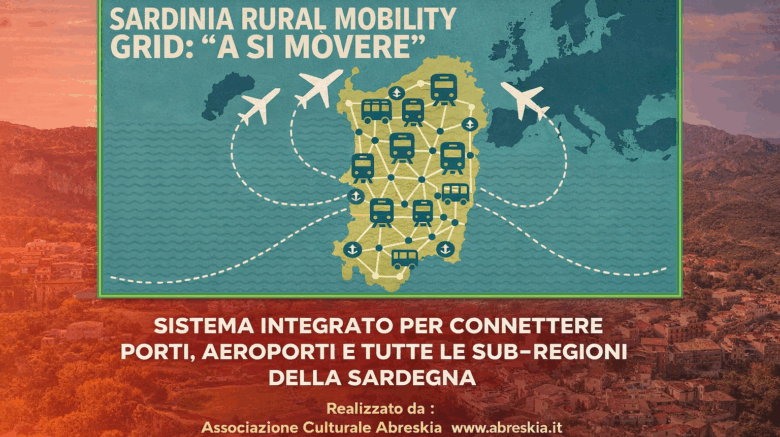
There Sardinia Rural Mobility Grid, project developed by the’Abreskia Cultural Association, arises from a question that directly affects the fate of the island: How can mobility contribute to building a more vibrant, more equitable, more sustainable Sardinia?
The answer isn't just technical, but profoundly cultural and social. In this vision, mobility is no longer a simple service, but becomes a tool for territorial justice, a bridge uniting communities, economies, and opportunities.
Sardinia is a diverse landscape, with strong identities and ancient histories. However, much of its riches are found in hard-to-reach places, often far from major transportation hubs. Here, potential exists, pulsating, and resisting... but it struggles to translate into development.
And it is exactly from this context that the project was born.
📌 Learn more about the project
 𝗙𝗹𝗶𝗽𝗕𝗼𝗼𝗸 𝘀𝗳𝗼𝗴𝗹𝗶𝗮𝗯𝗶𝗹𝗲
 Full version of the project, navigable online
https://fliphtml5.com/sxsmt/hqfj/
PDF DOWNLOADABLE ONLINE
👉 https://drive.google.com/file/d/15sUMwYvhMN0O3XLMnUjfNjiQQyWCpJ5g/view?usp=drive_link
An urgent challenge for the island's inland areas
For many citizens of small villages, move It's still a daily challenge:
- poor or irregular connections, especially on holidays
- distance from schools, hospitals, universities, offices
- tourism that focuses on the coasts, leaving the interior behind
- young people who leave to study or work and often do not return
The consequence is a vicious circle:
isolation → loss of services → depopulation → social and economic decline
In numbers:
- Beyond 300 out of 377 municipalities have fewer than 5,000 inhabitants
- More than 60 municipalities they realistically risk demographic extinction
- Only the 7% of tourists chooses the internal territories
This data is not just a critical issue, but a call to action.
Because a territory without people is a territory that stops telling its own story.
A modern, integrated network at the service of communities
The Sardinia Rural Mobility Grid wants to reverse the trend and generate a new virtuous cycle, where mobility becomes an accelerator of presence, vitality and attractiveness.
The proposal introduces:
- fast regional backbones which cross the island connecting ports and airports
- daisy chain local area networks that reach every village
- scheduled services with easy-to-remember times
- tariff integration with a single digital travel ticket
- on-call transport in the smallest and most isolated municipalities
- sustainable means, electric on local routes
The objectives are clear:
✈️ Reconnecting the countries at the main poles of the island
through efficient connections to Cagliari, Sassari, Olbia, Nuoro and Oristano
❤️ Making services accessible — school, health, culture, work
because the quality of life cannot depend on the postal code of residence
👨👩👧 Promoting internal territories
through tourism that respects, discovers and supports communities
🚗 Reduce emissions and dependence on private cars
making mobility more convenient, safe, shared
The network doesn't just transport people: carries possibilities.
👉Presentation slides
https://drive.google.com/file/d/15sUMwYvhMN0O3XLMnUjfNjiQQyWCpJ5g/view?usp=drive_link
Mobility as social infrastructure
Each race represents:
- a family that can stay and live in their own country
- a student who can train without having to migrate
- a grandparent who can reach visits and services
- a young worker who can return without giving up opportunities
- a tourist who can finally get to know the authentic Sardinia
Mobility allows rural residents to participate in cultural life of the island: festivals, museums, theaters, training courses become accessible, usable, and shareable again.
This means:
livelier communities, stronger economies, identities that continue to be passed down
Culture, tourism, and development: an ecosystem that can breathe again.
The Sardinia Rural Mobility Grid supports the birth of a new tourism model:
- car-free itineraries
- trains and buses to reach archaeological sites, natural parks, and scattered museums
- events in internal areas connected with dedicated services
Every place reachable becomes visitable.
Every place you can visit becomes tellable.
Every place that can be told becomes attractive.
According to our estimates:
- +2 million additional tourist presences in the interior by 2030
- +45% participation in cultural events in the villages
- new job opportunities for young people and professionals
Social inclusion and quality of life
The Sardinia Rural Mobility Grid also responds to the needs of the most vulnerable groups:
- tariff concessions for seniors, students and large families
- accessible fleet for people with disabilities
- synchronized shuttles with school hours and medical visits
This is not just a mobility project:
it's a project that puts people at the center.
Environmental sustainability and energy transition
Climate change is also having a strong impact on inland areas: fires, landslides, floods.
Reducing private traffic means:
- less CO₂
- less land consumption
- cleaner air
- greater road safety
The goal for 2030:
- -25% of cars on the main backbones
- almost the entire fleet electric
- energy produced from local renewable sources
Presented for the first time at Sardinia Unlocked 2025
The vision and operating model were previewed at Sardinia Unlocked 2025, an event dedicated to the possible futures of the island:
🔗 https://nodi-itaca.com/index.php/sardinia-unlocked/
The project has attracted interest and discussion from:
- sustainable mobility professionals
- public administrators
- cultural and tourism operators
- young innovators and active citizens
An important step: sharing the vision with a community that believes in change.
A more connected, inclusive, and sustainable Sardinia
The project is intended to be:
- scalable (first the interior, then the whole island)
- accessible (simple and participatory technology)
- realistic and sustainable economically in the long run
The Sardinia Rural Mobility Grid demonstrates that:
there's no need to invent another Sardinia, that's enough to mend the one that exists
Because if places come back to life, people come back to life too.
And when people come back, they come back:
- schools
- shops
- services
- hope
Strategic synthesis
The Sardinia Rural Mobility Grid is an investment in who we are and what we can become again.
Sardinia is not destined for depopulation:
can be reconnected, repopulated, regenerated.
Abreskia offers a concrete vision for a future where:
- no territory is left behind
- every inhabitant can exercise the right to move
- culture continues to circulate
- identity continues to generate life
🚍 Sardinia Rural Mobility Grid
a Sardinia that starts from the heart
𝗟𝗜𝗡𝗞 𝗔𝗜 𝗗𝗢𝗖𝗨𝗠𝗘𝗡𝗧𝗜
Promotional video – Creative vision of the “Sardinia Rural Mobility Grid” project
Audio-Story of Giampaolo Frongia – Founder of the Abreskia Project: https://open.spotify.com/episode/0203CZC3S3norCa7s41qgy?si=DKaLHcGeRFewSqrnAVcBuA
𝗙𝗹𝗶𝗽𝗕𝗼𝗼𝗸 𝘀𝗳𝗼𝗴𝗹𝗶𝗮𝗯𝗶𝗹𝗲 Full version of the project, navigable online
 𝗗𝗼𝗰𝘂𝗺𝗲𝗻𝘁𝗼 𝗶𝗻𝘁𝗲𝗴𝗿𝗮𝗹𝗲 𝗣𝗗𝗙 with analysis, vision and proposal
https://drive.google.com/file/d/15sUMwYvhMN0O3XLMnUjfNjiQQyWCpJ5g/view?usp=drive_link
 𝗦𝗹𝗶𝗱𝗲 𝗣𝗗𝗙 – 𝗦𝗶𝗻𝘁𝗲𝘀𝗶 𝗱𝗲𝗹 𝗽𝗿𝗼𝗴𝗲𝘁𝘁𝗼 Schematic and immediate presentation of the key points
https://drive.google.com/file/d/1SuQ3PMqDDN7rh_axSu0nAVsY6vDNzULg/view?usp=drive_link
 𝗔𝗿𝘁𝗶𝗰𝗼𝗹𝗼 𝘀𝘂𝗹 𝗕𝗹𝗼𝗴 𝗔𝗯𝗿𝗲𝘀𝗸𝗶𝗮
An in-depth editorial analysis of the project and the topic of mobility in inland areas
