
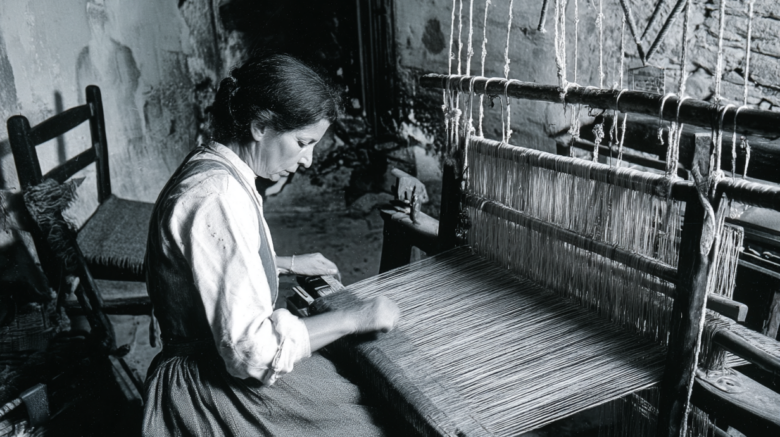
In the geographical heart of the Sardinia, among the silent hills of Mandrolisai, a town has for centuries preserved one of the most extraordinary artisanal heritages of the Mediterranean. Samugheo, a small town in the province of Oristano, has been known for centuries as the beating heart of the island's weaving industry. A title not merely celebratory, but deeply earned, woven thread by thread over the centuries.
The origins: the loom as the heart of the home
By tradition in Samugheo the’art of weaving It was practiced by almost all women of all social classes. The trousseau and other types of clothing were produced at home on the loom, personalizing some items, such as the covers for the bed, which were passed down from mother to daughter; sheet, i case cover, The tapestries, the tablecloths, the saddlebags.
The chassis it wasn't just a tool: it was the center of women's life. From a young age, girls learned the art of weaving from their mothers and grandmothers, thus passing on the techniques and secrets of the trade. The master weavers of Samugheo were considered true artists, capable of creating unique and precious works of art.
Fabric weaving has never been just a craft: it's part of our collective identity, a gesture repeated over time that tells stories, emotions, rituals, and beliefs.
Techniques: the grammar of an ancient art
Understanding Samugheo weaving means knowing its technical vocabulary, made up of Sardinian terms that describe precise and ancient gestures.
The most famous technique is that to pigeons —literally "grains"—in which small weft cords are wrapped around a metal rod and held in place, creating raised dots that form geometric borders, plants, or stylized animals. The relief is the distinctive feature, and the pattern can be felt with the fingers.
Alongside the pibiones, other fundamental techniques of the Samughese tradition coexist:
- The rough wool: an ancient felted wool used for cloaks and workwear. The production of orbace is one of the oldest in Sardinia and requires a great deal of traditional knowledge. The various yarns are passed on the loom, then ready to be dyed with natural herbs, following the ancient technique.
- A travos (slit weave): work on a vertical loom with exposed weft, used for large decorative tapestries.
- In gauze (rezza): open weave obtained by crossing adjacent warps, often then embroidered, used for light fabrics and fine linens.
Recognition: From Grazia Deledda to the International Market
The Sardinian textile tradition has also been celebrated by important Sardinian writers. Among them, Grazia Deledda, who often described the beauty and value of carpets in her novels. In particular, in the novel Reeds in the wind, the writer describes the figure of a master weaver as a strong and tenacious woman, guardian of the tradition and culture of her people.
Since 1965, when the first weavers' cooperative was established in Samugheo, attention to this type of traditional wealth has gradually increased, and the vision for the future of these productions has broadened: from the predominantly family and domestic dimension to the market, and from the local to the regional and then global market.
Since the 1970s, significant innovations have occurred in artisanal weaving: training courses were established and cooperatives were formed. Small looms were replaced with larger ones, and a sales network and contacts were established, adapting the product to the tastes of the time.
The MURATS: memory becomes a museum
In 2002 this heritage found a permanent home. The MURATS — acronym for the Regional Museum of Sardinian Textile Art — preserves, showcases, and promotes the island's priceless heritage of manufacturing excellence. It is located in Samugheo, a village in the Mandrolisai area, long renowned for its thriving textile production.
The permanent collection comprises a collection of wool, cotton, and linen items from various parts of the region, created between the late 18th and the second half of the 20th century. It features blankets, sheets, children's and everyday linens, chest covers, saddlebags, traditional clothing, shepherd's garments, and the tools used to make them, particularly traditional wooden looms.
Among the rarest pieces are the Affaciadas, very small strips of finely worked fabric that were displayed on the balconies during the Corpus Domini procession, and the five Poor thing, the dead, funeral drapes dating back to the eighteenth century, made with a particular technique on a horizontal loom, with zoomorphic and anthropomorphic figures symbolically linked to the passing of the deceased.
The museum organizes workshops, seminars, laboratories, internships, and apprenticeships. The visit includes an educational program that includes a weaving demonstration.
Tessingiu: When Craftsmanship Becomes a Celebration
Tessingiu It is a summer exhibition that brings together weavers and artisans through curated displays, stalls, and demonstrations, making Samugheo the most accessible place to understand Sardinian weaving in its context: watching the looms in action and speaking directly with those who work them.
Tessingiu was born from the first event organized by the Samugheo Pro Loco, the "Mandrolisai Crafts Exhibition," with the aim of preserving this ancient art. This fair showcases traditional crafts alongside unique pieces of modern craftsmanship, making it unique and diverse, among the richest in the Mediterranean.
A living heritage, not just preserved
Despite their deep roots in tradition, Samugheo's textile companies have successfully combined artisanal heritage with innovation, maintaining a distinctive style that reflects the history and soul of Sardinia.
Craftswomen like Isabella Frongia —whose work Abreskia has already described—represent this creative continuity: not simply preservers of a tradition, but interpreters capable of innovating and making it accessible without betraying its roots. Women's hands have woven, generation after generation, an invisible thread that unites past and present.
Visiting Samugheo means immersing yourself in this ongoing story. Entering a workshop, watching a weaver's hands move on the loom, listening to the rhythmic cadence of the machinery at work: it's an experience you'll never forget. Because it speaks, better than any words, to what it means to truly preserve a heritage, and the certainty that certain traditions deserve to live on.